BOOK AUTHOR | MAGAZINE WRITER | TRAVELER
ANDREW LAWLER
BOOK AUTHOR | MAGAZINE WRITER | TRAVELER
ANDREW LAWLER
“A Perfect Frenzy” is a sharp-eyed look at the messy, sometimes absurd, often cruel birth pangs of a nation.”
—The New York Times
“Andrew Lawler finds fresh voices and novel ways of looking at the start of the Revolution—and, best of all, he offers the historian’s holy grail of an original argument.”
–Woody Holton, author of Liberty is Sweet
“A riveting and illuminating account of a pivotal episode in American history – a polished gem of a book.”
–David Zucchino, Pulitzer Prize winner and author of Wilmington’s Lie
“Elegantly written and impeccably researched, this pathbreaking book is a gift this troubled nation needs as it approaches its 250th anniversary.”
–Gerald Horne, author of The Counter-Revolution of 1776
“A masterful job”
—Virginian Pilot
Order A Perfect Frenzy now, or visit your local bookstore!
A Perfect Fenzy
Order A Perfect Frenzy at these booksellers, or visit your local bookstore!


“A Perfect Frenzy” is a sharp-eyed look at the messy, sometimes absurd, often cruel birth pangs of a nation.”
—The New York Times
“Andrew Lawler finds fresh voices and novel ways of looking at the start of the Revolution—and, best of all, he offers the historian’s holy grail of an original argument.”
–Woody Holton, author of Liberty is Sweet
“A riveting and illuminating account of a pivotal episode in American history – a polished gem of a book.”
–David Zucchino, Pulitzer Prize winner and author of Wilmington’s Lie
“Elegantly written and impeccably researched, this pathbreaking book is a gift this troubled nation needs as it approaches its 250th anniversary.”
–Gerald Horne, author of The Counter-Revolution of 1776
“A masterful job”
—Virginian Pilot
Order A Perfect Frenzy now, or visit your local bookstore!
A Perfect Fenzy
Order A Perfect Frenzy at these booksellers, or visit your local bookstore!
“A Perfect Frenzy” is a sharp-eyed look at the messy, sometimes absurd, often cruel birth pangs of a nation.”
— The New York Times
“Andrew Lawler finds fresh voices and novel ways of looking at the start of the Revolution—and, best of all, he offers the historian’s holy grail of an original argument.”
–Woody Holton, author of Liberty is Sweet
“A riveting and illuminating account of a pivotal episode in American history – a polished gem of a book.”
–David Zucchino, Pulitzer Prize winner and author of Wilmington’s Lie
“Elegantly written and impeccably researched, this pathbreaking book is a gift this troubled nation needs as it approaches its 250th anniversary.”
–Gerald Horne, author of The Counter-Revolution of 1776
“A masterful job”
—Virginian Pilot
Order A Perfect Frenzy now, or visit your local bookstore!
A Perfect Fenzy
Order A Perfect Frenzy at these booksellers, or visit your local bookstore!
Frequently asked questions about A Perfect Frenzy
Andrew Lawler: “I grew up in a history-minded family in Virginia. A few years ago, while doing a magazine story, I learned that much of what I had been taught about the Revolution’s start in my home state was incomplete at best. That motivated me to dig into what really took place–and why.”
What’s the book, A Perfect Frenzy about?
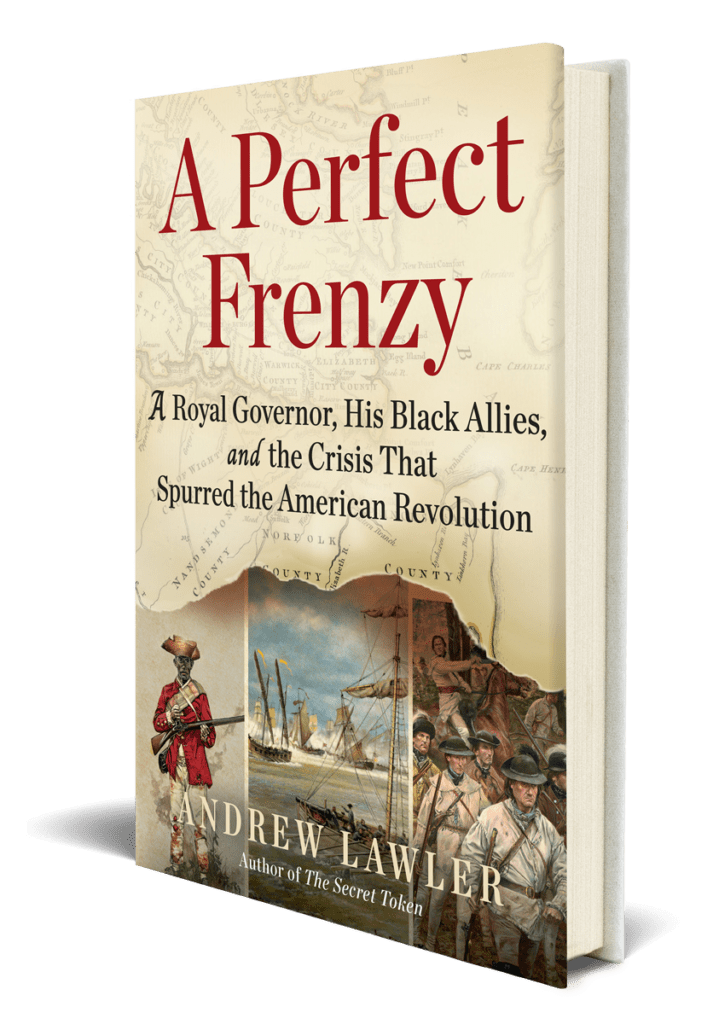
As the American Revolution broke out in New England in the spring of 1775, dramatic events unfolded far to the south that proved every bit as decisive as the battles of Lexington and Concord in uniting the colonies against Britain. Virginia, the largest, wealthiest, and most populous province in British North America, was governed by Lord Dunmore, a pugnacious Scottish earl.
Outgunned and outmanned, he allied with the colony’s enslaved Africans, who made up two of every five Virginians and were eager to gain their freedom. Dunmore emancipated those who would fight for King George III and sent them into battle against their patriot owners as part of the first corps of Black soldiers in American history. The crisis that gripped Virginia in 1775 and 1776 has long been relegated to the background by historians. That is due in large part to the uncomfortable fact that the conflict pitted two groups of liberty-seeking Americans against one another.
A Perfect Frenzy: A Royal Governor, His Black Allies, and the Crisis That Spurred the American Revolution shows how the upheaval in Virginia shaped the course of the Revolution–and sheds light on the issues of race, gun control, immigration, and the split between city and country that continue to divide the nation.
How can I contact Andrew Lawler?
I want Andrew Lawler to give a presentation in my area to commemorate the 250th anniversary of the American Revolution.
Reach out to Andrew regarding potential speaking opportunities:
Contact Andrew Lawler Here
I’m with the Press/Media, how can I schedule an interview/meeting with Andrew Lawler?
Contact Andrew and include the name of your publication, podcast, or website:
Contact Andrew Lawler Here
How do I keep up-to-date on what’s happening with Andrew Lawler, his latest articles, and the book tour?
Follow Andrew Lawler on social media:
How can I learn more?
• Purchase a copy of A Perfect Frenzy at your local bookstore
• Check out the calendar and attend one of Andrew’s talks
• Post a review on Goodreads or Amazon
• Comment on the social media posts about the book
REVIEWS
Editor’s Choice — New York Times
EDITOR'S CHOICE -- THE NEW YORK TIMES
New Books We Recommend This Week
Suggested reading from critics and editors at The New York Times.
Feb. 6, 2025, 4:04 p.m. ET
A PERFECT FRENZY:
A Royal Governor, His Black Allies, and the Crisis That Spurred the American Revolution
Andrew Lawler
Lawler recounts the story of John Murray, the Earl of Dunmore, a Scotsman installed as the governor of colonial Virginia shortly before the American Revolution who, among other efforts on Britain’s behalf, created a regiment of formerly enslaved Black soldiers to help fight the war. The author — a journalist who proves himself at home in historical archives — deftly dissects Dunmore’s choices in the midst of mounting revolutionary crises, revealing a man caught between competing loyalties and a rapidly shifting political landscape.
“A sharp-eyed look at the messy, sometimes absurd, often cruel birth pangs of a nation. It prompts readers to question the simplistic narratives that have shaped our understanding of this pivotal period.”
From Alexis Coe’s review
New York Times
THE NEW YORK TIMES
By Alexis Coe
The Ironic Fight Against Liberty in the American Revolution
In “A Perfect Frenzy,” Andrew Lawler reveals the hypocrisies of the patriots on the battleground of colonial Virginia.
“Damn Virginia,” thundered John Murray, the Earl of Dunmore, at news of his gubernatorial reassignment in the American colonies. The reluctant Scottish aristocrat saw no advantage to his relocation from cosmopolitan New York to the “torpid and sickly rural backwater” of Virginia. The year was 1771. It ended up being so much worse than he imagined.
But first, there was a honeymoon. The tartan-clad royal import went full Virginian, buying two forced labor camps and enough enslaved people to work them. He cut a wide swath through colonial high society, discussing architecture with Thomas Jefferson and planter concerns with George Washington.
Then came the revolutionary tempest that had been brewing beneath the surface of every genteel exchange. By June 1775, Dunmore stood at the helm of a collapsing system of governance: Patriots ignored orders, courts closed and dissolved the General Assembly after Virginia’s colonists pledged support for Massachusetts’s tea-tossers. Dunmore removed gunpowder from the Williamsburg magazine to a British ship. The revolutionaries called him a liar, a rapist and a dunce. Washington condemned him as “that arch-traitor to the rights of humanity.”
That’s the story the journalist Andrew Lawler learned as a boy in Virginia, but after a Black History Month assignment for National Geographic sent him poking around old historic haunts, he stumbled upon the Ethiopian Regiment; in 1775, Dunmore armed hundreds of Black volunteers who’d fled their patriot enslavers in exchange for freedom. Lawler began to wonder if the crown’s maligned minion was actually a complex figure caught in the maelstrom of revolutionary fervor.
The absorbing result of his meticulous research is “A Perfect Frenzy,” a new exploration of the crucible of colonial America. The author deftly dissects Dunmore’s choices in the midst of mounting revolutionary crises, revealing a man caught between competing loyalties and a rapidly shifting political landscape.
Lawler is especially good at casting a spotlight on the hypocrisy of the early insurrectionists as well as the double bind of Black Americans forced to navigate the treacheries of the Revolution. Fleeing an alarming number of men who were nearing the capital by land, Lord Dunmore established a “floating town” of 100 vessels off the coast of Virginia that became less a fief and more a purgatory, desperately cruising the Chesapeake in search of a friendly shore. A patriot-leaning Williamsburg newspaper chronicled his alleged “promiscuous ball” with “Black ladies” as guests but the grim reality was far from festive. These ships were floating petri dishes where typhus and smallpox played a deadly duet in the crowded holds. The Black passengers, already trying to escape one form of oppression, found themselves trapped in another, suffering disproportionately from cold, hunger and abysmal sanitation. More than 100 people died.
To underscore how intense the tension was on deck and on ground, the “crisis” in Lawler’s subtitle hasn’t even happened yet. It was “Dunmore’s Proclamation,” in November 1775, that promised freedom to enslaved people who joined the British military, that struck terror into the hearts of Virginia’s patriots. There was one exception: Enslaved people belonging to loyalists were promptly returned; the nearly 100 people Dunmore held in bondage fell in that category and he did nothing to help them out.
The proclamation wasn’t just an announcement and the Ethiopian Regiment wasn’t just a military unit; they were glitches in the colonial matrix, a paradox that short-circuited the Enlightenment narrative. “How is it that we hear the loudest yelps for liberty among the drivers of Negroes,” mused the English moralist Samuel Johnson.
Operating under the royal governor’s aegis, the regiment spread a contagion of hope through the enslaved population. Dunmore’s Black regiment reportedly wore uniforms that bore the phrase “Liberty for Slaves” — a nod to the revolutionary cry of “Liberty or Death.” For the patriots, it was a nightmare made flesh: armed, free Black men empowered to fight back. Dunmore’s proclamation, which was echoed and amplified by other British generals, became a catalyst rivaling the Boston Tea Party and the Battles of Lexington and Concord in its power to galvanize the patriots. “Lord Dunmore has commenced hostilities in Virginia,” wrote Jefferson, who enslaved over 600 people during his lifetime. “It has raised our country into a perfect frenzy.”
The irony of the rebel position apparently occasioned some thought but little deep reflection. As Lund Washington wrote to his now world-famous cousin George in December 1775, the “dreaded proclamation” might lead some of those enslaved at Mount Vernon to escape. Who could blame them, he went on: “Liberty is sweet.”
Indeed, while General Washington, commander in chief of the Continental Army, waxed poetic about freedom on far-flung battlefields, more than a dozen of the hundreds of people he held in perpetual bondage would eventually vote with their feet, fleeing his five farms for a sworn enemy. They ran to the British lines even after pragmatism trumped prejudice and Washington’s ban on Black soldiers in the fight for independence was lifted. (When the war was over, the general demanded that the men who had taken refuge with the British Army be returned to him. The request was denied.)
Ignited by a resolve forged in defiance, the patriots were ready to burn it all down. On Jan. 1, 1776, Dunmore’s forces unleashed a cannonade on Norfolk, a loyalist stronghold overtaken by patriots. But it was the patriots themselves, spurred on by Jefferson and colonial authorities, who transformed this military action into wholesale destruction. After plundering the town, they set it aflame, leaving not a single church standing. In three days, Norfolk was reduced to ashes.
Lawler calls this “the greatest single war crime of the conflict,” a dubious honor long pinned on Dunmore, though it needn’t be. A 1777 patriot investigation revealed the stark truth: Of 1,333 buildings razed, patriots torched 1,279 to Dunmore’s 54. Yet this report was buried for six decades, allowing the myth of Dunmore’s villainy to make its merry way into our collective memory.
Just about every early American historian — yours truly included — has touched on Virginia’s last royal governor’s last year in America, distilling the highlights into our broader narratives. And there have been excellent books on free and enslaved Black people in Virginia. Still, Lawler’s laser focus on Dunmore’s tumultuous swan song stands out as a rare, if not singular, feat. He isn’t a historian but when it comes to research, he does an excellent impression of one. (There are some tells along the way: I clutched imaginary pearls at a chapter titled “Dunmore’s Dunkirk,” but in the end, such moments were few and far between.)
“A Perfect Frenzy” is a sharp-eyed look at the messy, sometimes absurd, often cruel birth pangs of a nation. It prompts readers to question the simplistic narratives that have shaped our understanding of this pivotal period in American history. “We can feel revulsion for the acts of patriots,” Lawler argues, “and respect their enemy without betraying the founders’ call for a more just and equitable society.”
The struggle for racial justice, the ever-contentious role of government and the moral failures behind the pursuit of freedom are specters that continue to haunt us today. As we approach America’s 250th in 2026, Lawler’s history offers us the kind of challenge we should be posing to our revolutionary mythology. In Dunmore’s story, we find an uncomfortable truth: Our most cherished narratives can cast the deepest shadows.
Kirkus
Kirkus
Accounts of the American Revolution’s outbreak often focus on Massachusetts, but there was plenty of action in Virginia, the largest colony.
Journalist and historian Lawler, author of The Secret Token: Myth, Obsession, and the Search for the Lost Colony of Roanoke, introduces John Murray, the Earl of Dunmore (1730-1809), Virginia’s royal governor from 1771 until he fled in 1775. As governor he represented British authority but could make no laws and possessed no police or military force. This caused no problems at first because he and Virginia’s elite shared the same goal—to enrich themselves by acquiring huge lands beyond the Appalachians by expelling the Indians (already expelled from Virginia itself). After a few years, his popularity plummeted as he tried to discourage opposition to new parliamentary taxes and then suppress an increasingly organized rebellion. To strengthen his minuscule forces, he issued the famous Dunmore’s Proclamation in November 1775, promising freedom to slaves who volunteered to bear arms for the crown. This produced—in addition to outrage among Virginia patriots—a few thousand Black volunteers. Formed into fighting units, they skirmished with rebels and didn’t do badly. But preoccupied elsewhere, Britain gave Dunmore little help. After a year of steady retreating, he abandoned Virginia, sailing off with ships packed with loyalists and escaped slaves. He continued to urge superiors to recruit enslaved people. Many considered it a good idea, but it was never official policy. Lawler joins a new generation of scholars who have determined that the earl’s proclamation makes him a pioneering hero in the campaign against slavery. He also gives Britain high marks for refusing to return the former slaves. This infuriated America’s leaders, Washington and Jefferson included, who maintained that they were stolen property who rightfully belonged to their owners.
A convincing rehabilitation of Dunmore, plus another dollop of clay added to the feet of our Founding Fathers.
Journal of the American Revolution
Journal of the American Revolution
by Patrick H. Hannum
Andrew Lawler’s recent text artfully focuses on an important and understudied American Revolutionary period, Virginia in 1775 and 1776, and topic, slavery. The title, A Perfect Frenzy: A Royal Governor, His Black Allies, and the Crisis that Spurred the American Revolution, describes his theme. His text follows the story of John Murray, Lord Dunmore, the last royal governor of the Colony of Virginia, and his efforts to build an army to counter Virginia’s Patriots and retain royal authority in the colony in the early years of the American Revolution. Dunmore’s most loyal and reliable allies in this effort were the thousands of enslaved Virginians that made up one third of the colony’s population.
This is an important work because Lawler gives a voice to thousands of unnamed individuals as he describes events unfolding in Virginia. He follows Dunmore with his assignment as Virginia’s royal governor in 1771 that ends with his first departure from North America in 1776. Although he returned to Great Britian, Dunmore did not relinquish his position as royal governor. The author includes a discussion of Dunmore’s return to North America late in the war in an attempt to regain royal control of Virginia, again advocating for the recruitment and training of Black soldiers. He also explains how effective Patriot propaganda and messaging influenced the negative characterization of Dunmore that continues to this day.
While describing an extensive series of political and military events, the author weaves in his overarching theme addressing the enslaved Virginians that rallied to Dunmore in search of freedom. Lawler includes discussion of all the key military and political events including but not limited to engagements at Hampton, Kemp’s Landing, Great Bridge, Norfolk, Gwynn’s Island and St. George’s Island, Maryland. Dunmore formally announced his policy to liberate the enslaved and indentured servants in an emancipation proclamation issued in November 1775 in Princess Anne County, now the City of Virginia Beach, following the engagement at Kemp’s Landing.
Dunmore’s story and that of his Black allies is not a particularly happy one; there are few winners, at best mostly survivors. Slavery was a brutal system of human control and war only made it uglier. Many of Dunmore’s Black supporters died from disease, and some were captured, executed or returned to slavery. With a lack of land forces, support from the British Navy was a critical component in keeping Dunmore in the fight and assisting his allies. Lawler does not overstate the importance of slavery; the author provides a balanced and thoughtful discussion and analysis on the impact slavery had on the Revolution in Virginia. Virginia’s history of slave labor is a sensitive subject for many but Lawler mindfully describes Dunmore’s careful balancing act with emancipation, citing its wartime necessity to preserve British colonial rule in the hemisphere and crush the rebellion.
Anyone who attempts to research and report on individuals of color, free, enslaved, native, Patriot and Loyalist will become frustrated with the lack of surviving individual Revolutionary era records, similar to the challenges faced in African-American genealogy. With a few exceptions, individual stories are very difficult to document because of the lack of written records. Lawler solves this challenge by using surviving records from the period. Simply based on proximity, numbers and other surviving records, Lawler documents that individuals of color were active participants in the Revolution. In 1775, 200,000 of Virginia’s 600,000 residents were Black, most enslaved. The author brings life to the story of thousands without knowing their names. Most were not literate but Lawler uses surviving official government accounts and personal records naming Dunmore and his allies to explain their roles and contributions.
Andrew Lawler is an accomplished writer and conducted extensive research for this text. He identified and referenced an impressive list of primary sources in his endnotes. He clearly consulted a wide body of secondary material. More importantly, his analysis provides contemporary relevance to the enduring issues he identifies. He draws parallels between Lincoln’s Emancipation Proclamation of 1862 and Dunmore’s of 1775. He also describes Dunmore’s role in helping 8,000 formerly enslaved people leave the United States for freedom in other parts of the world as the Revolution ended. Interestingly, he describes how Virginia’s insistence on the authority and control of individual colony or state legislatures influenced the development and authority of the federal government, highlighting the concept of states’ rights. He brings relevance to contemporary issues of state vs. federal control.
Anyone with an interest in Virginia or Revolutionary history will find something of value to take from this text. Those who study slavery, government, or civil rights will find Lawler’s work insightful. Although dense with information on events and scholarly research, the text is neatly organized, well written and easy to read. Recreational readers or historians will enjoy the read. The release of this book in early 2025 makes it a valuable resource for Revolution 250 activities and events.
The Wall Street Journal
The Wall Street Journal
Read on thewallstreetjournal.com
by Gerard Helferich
‘A Perfect Frenzy’ Review: The Virginia Rising
As tensions grew between American colonists and the British crown, the strategic importance of the largest, wealthiest colony became clear.
When we recall the places where the simmering feud between Great Britain and its American colonies boiled into revolution, we may think of Boston, with its eponymous massacre and tea party; Lexington and Concord, scene of “the shot heard round the world”; and Philadelphia, site of the Continental Congresses. But in “A Perfect Frenzy,” Andrew Lawler reminds us that Virginia, not Massachusetts or Pennsylvania, was the largest and wealthiest of the 13 colonies, and that without the crucial events that unfolded through the 1770s in places such as Williamsburg, Norfolk and Richmond, the Declaration of Independence might never have been signed.
The grievances of mercantile New England centered on issues such as taxes and trade restrictions. But in his compelling, impeccably researched account, Mr. Lawler, a journalist and author whose previous books include an investigation of the Lost Colony of Roanoke, shows that Virginians were galvanized by a different threat. They feared the emancipation and arming of their enslaved workers, who constituted a large slice of the colony’s population and the majority of their owners’ wealth.
As in the northern colonies, revolution came gradually to Virginia. In June 1774, Virginia’s House of Burgesses responded to Britain’s punitive closure of Boston’s port with a resolution calling for a day of fasting and prayer in support of the Massachusetts patriots. After Lord Dunmore, the Scottish earl who was governor of Virginia, dissolved the body in response, the burgesses continued to meet in a nearby tavern, joining the call for a general congress of all the colonies. In March 1775, the Virginia Convention, the burgesses’ revolutionary successor, convened in Richmond and took the provocative step of establishing a volunteer militia, after Patrick Henry challenged, “Is life so dear, or peace so sweet, as to be purchased at the price of chains and slavery?. . . I know not what course others may take; but as for me, give me liberty, or give me death.”
As the colonies edged closer to rebellion, both loyalists and patriots recognized Virginia’s unique importance. Its manpower and resources were crucial to the American struggle, and its central location made it a strategic keystone. As Mr. Lawler writes: “Without Virginia’s firm support, the patriot cause might collapse into small regional rebellions, uprisings more easily extinguishable by London.”
The Virginian Pilot
The Virginian Pilot
UPDATED: March 28, 2025 at 9:14 AM EDT
Book review: ‘A Perfect Frenzy’: Who torched Norfolk in 1776?
Blame the Patriots more than the cunning Dunmore. Andrew Lawler’s latest book is a lively gathering of research into area’s importance to the Revolution.
Many students of American history know that the Revolutionary War effectively ended at Yorktown, Virginia, when in 1781 the British forces under Lord Charles Cornwallis surrendered to the American and French forces under Gen. George Washington. But far fewer know about the important role that the rest of Hampton Roads, particularly Norfolk, played in the months before and after the adoption of the Declaration of Independence on July 4, 1776. Andrew Lawler’s interesting and important book “A Perfect Frenzy” should do much to close that gap.
“A Perfect Frenzy: A Royal Governor, His Black Allies, and the Crisis That Spurred the American Revolution” by Andrew Lawler. (Atlantic Monthly Press)
Although most of the information in Lawler’s book has long been known, the author does a masterful job of assembling it in one place in a lively and readable manner. His two main arguments are that the Patriots, not the British, were primarily responsible for burning Norfolk in early 1776 and that British emancipation of enslaved people in late 1775 and early 1776 was a major cause of the Revolution. Lawler does a commendable job of providing facts and figures, many from primary sources, to support his claims, with the result that readers get a fresh look at a key turning point in American and world history.
Tensions between the Virginia colony and the crown rose a few years after the appointment in 1771 of the Scot John Murray, fourth Earl of Dunmore, as governor. He became a slave owner, prosecuted “Lord Dunmore’s War” against the Shawnee and Mingo in the trans-Appalachian region of the colony, and developed a friendship with Washington. But he had difficult relations with Virginia’s House of Burgesses, and his hold on power waned as the colonists’ desire for separation from Great Britain grew, famously exemplified by Patrick Henry’s “Give me Liberty or give me Death!” speech in March 1775.
Dunmore fled the Colonial capital of Williamsburg and, after being wounded by rebels, took refuge aboard a British naval vessel. Eventually he and his forces retreated to what he called “the dirty little borough of Norfolk.” Actually, Norfolk was the largest town in Virginia and the eighth-largest town in the Colonies. Home to a number of Scottish-born merchants and characterized by more social mixing of the races than anywhere else in Virginia, the seaport was known for its strong Loyalist sympathies.
“Part of the Province of Virginia.” A pen-and-ink and watercolor map from the era, about 1791, showing “Princess Ann County,” Norfolk County and part of Nansemond County. It places north at the bottom and south at the top. Great Bridge and Kemp’s Landing — sites of major battles — are visible just to the left of the southern and eastern branches of the “Elisabeth River.” (Library of Congress)
Dunmore was astute enough to realize that Virginia’s large enslaved population — more than 200,000 people, almost half the Colonies’ total — was a major vulnerability. Hence, in November 1775 he issued his “Offer of Emancipation,” which granted freedom to enslaved people “able and willing to bear Arms” who left Patriot owners to join the British cause. A few days earlier Thomas Jefferson had claimed that a recent British naval raid on Hampton had “raised our countrymen into [a] perfect frenzy,” and Dunmore’s offer must have contributed to that feeling. Although the exact numbers are uncertain, enough formerly enslaved people came to Dunmore for him to form the “Ethiopian Regiment,” composed of several hundred Black soldiers. (Washington subsequently allowed free African Americans to serve in his army.)
Dunmore’s forces won the Battle of Kemp’s Landingon Nov. 15, 1775, but lost the Battle of Great Bridgeon Dec. 9. (Those sites are in today’s Virginia Beach and at the Elizabeth River in Chesapeake.) Then Dunmore, his white and Black soldiers, and many Loyalist civilians took refuge aboard British naval and merchant ships in the Hampton Roads harbor — perhaps as many as 3,000 people on 200 ships, large and small. Faced with sniping by Patriot “shirtmen” (soldiers wearing hunting shirts), Dunmore ordered a ships’ cannon bombardment of Norfolk on Jan. 1, 1776, and sent troops ashore to burn waterfront warehouses that the shirtmen used for cover.
Angered by the bombardment, which lasted from seven to 11 hours, the burning of the warehouses, and the Norfolk Loyalists’ provisioning of Dunmore’s “fleet,” the poorly disciplined shirtmen set fire to much of the rest of Norfolk. The combination of Dunmore’s attacks and the Patriots’ response left Norfolk largely a charred ruin. In late 1777, Virginia’s new government conducted a study which concluded that of 1,333 buildings, the British had destroyed 54 and the Patriots 1,279. But that study was not made public for 60 years, and Dunmore has received most of the blame for the town’s burning.
From Lord Dunmore’s siege on Jan. 1, 1776: A cannonball and one of the few buildings that survived — what’s now St. Paul’s Episcopal Church, on St. Paul’s Boulevard in downtown Norfolk. (Gary C. Knapp, freelance / File)
As Lawler notes, among the many reasons the Declaration of Independence gives for separation from Great Britain are that the British “burnt our towns, and destroyed the lives of our people” and “excited domestic insurrections amongst us,” that is, revolts by enslaved people. Dunmore was also thought to have endeavored to incite Native Americans to attack colonists, and the Declaration accuses the British of that as well.
Dunmore’s fleet left Hampton Roads in May 1776, and the British held out for a time on Gwynn’s Island in the Chesapeake Bay about four miles southeast of modern Deltaville. But disease, including smallpox, and lack of supplies reduced the number of effective troops to a few hundred, and in August Dunmore left for New York. (He was later governor of the Bahamas, where he again became a slave owner.) In 1776 Abigail Adams wrote that although she was “willing to allow [Virginia] great merit for having produced a Washington,” she thought Virginians had “been shamefully duped by a Dunmore.”
In giving readers this fresh look, Lawler generally succeeds in being even-handed among Patriots, Loyalists and the British. But his understandable desire to realistically portray the Patriots occasionally leads him to cast them in a worse light than perhaps the facts warrant. For example, he writes of the British planning a “surprise” attack when three pages earlier he characterized the Patriots as making a “sneak” attack (a more loaded word often used to describe the Japanese attack on Pearl Harbor in 1941). More seriously, he twice calls the Patriots’ burning of Norfolk buildings a “war crime,” but he never identifies any legal framework of that era under which their actions would have been considered a crime. He also does not make clear whether Dunmore’s hours-long bombardment of Norfolk — a largely civilian target that housed many women and children — and his own burning of numerous buildings were part of that alleged crime or a separate crime or any crime at all.
Although not a perfect read (what book is?), “A Perfect Frenzy” is a well-researched, well-written, and colorful retelling of a tale with which more people should be familiar. Lawler, an experienced and widely published journalist, wrote the national bestseller “The Secret Token,” about the Lost Colony of Roanoke, and “Under Jerusalem,” about the archaeological history of what he calls “the world’s most contested city”; that book was honored by the Archaeological Institute of America. A contributing editor for Archaeology magazine and a contributing writer for the journal Science, he grew up in Norfolk and lives in Asheville, North Carolina.
Dunmore does not deserve the amount of blame he received back then and since, but his actions in Virginia in 1775 and 1776 ensured that history would not treat him kindly. Journalism has been called “the first draft of history,” and the Williamsburg Gazette reported in December 1775 that because of his hostility toward the Patriots, his erstwhile constituents “Norfolk, Hampton, and all the river settlements are threatened with fire and sword.”
Timothy J. Lockhart is a Norfolk lawyer, a retired Navy Reserve captain, and the author of six mystery and thriller novels, all from Stark House Press.
Style Weekly
Style Weekly
By Karen Newton
June 10, 2025
When author and journalist Andrew Lawler was growing up, history wasn’t in books, it was what his family did on weekends. Apart from Appomattox, there isn’t a colonial or Civil War battlefield site in Virginia that the family didn’t visit.
Williamsburg, Yorktown, and Jamestown were as familiar as Lawler’s own home.
“My grandparents would see an old house and shamelessly knock on the door to ask for a tour,” he recalls. “When we spoke of the author of the Declaration of Independence, it was of Mr. Jefferson.”
Lawler’s latest book, “A Perfect Frenzy: A Royal Governor, His Black Allies, and the Crisis that Spurred the American Revolution” explores the little-known story of the early American Revolution in Virginia, focusing on Lord Dunmore, an earl and the colony’s royal governor. Lawler comes to the Library of Virginia to discuss the book as part of the library’s programming commemorating Virginia’s role in the 250th anniversary of American independence.
After writing a piece on Lord Dunmore’s Ethiopian Regiment a few years ago, Lawler realized that much of what he’d been taught was either incomplete or inaccurate. The earl was not the villain he’d learned of as a child. Using his journalistic instincts to probe the historical record, Lawler discovered a history radically different from the expected tale of good guys versus bad guys.
He spent three years pulling the story together, probing archives in Scotland and England as well as the U.S. He found himself going down multiple rabbit holes to unearth more, learning of the earl’s youth fighting for Bonnie Prince Charlie in the 1745 rebellion against King George II and the important role played by the Shawnee and other indigenous tribes as the Revolution gathered force.
Readers may be surprised to learn the full story of the crisis that spurred the revolution. While New Englanders were upset about taxes on tea, elite Virginians in 1775 were far more focused on King George III’s refusal to allow them to own land west of the Appalachians. People like George Washington wanted indigenous lands in the Ohio Valley, but Britain wanted to avoid an expensive war.
With the prospect of owning more land, Virginia’s conservative gentry considered the radical step of independence. “And Dunmore’s move to free their enslaved workers felt to them like a dagger to their social and economic well-being,” Lawler says. “The liberty of others was a threat to their own notion of freedom.”
As for how it could be that Lord Dunmore had Black allies at that time, Lawler says it’s as simple as war making odd bedfellows. Dunmore was a slave-owning member of the gentry, but with British troops based in Boston, he needed a local army to fight the patriots. “Four out of ten Virginians were enslaved, and eager to gain their liberty,” he says. “So, both had an interest in allying with the other to defeat the rebels. And they very nearly succeeded.”
Lawler’s most moving – and disturbing – research moment came when he opened a box in the Library of Virginia that contained heartrending depositions made by eyewitnesses to the burning of Norfolk on Jan. 1, 1776. They describe patriot soldiers ruthlessly and intentionally burning the town, forcing women in labor from their beds, setting pharmacies aflame, and looting the homes of the elderly. “It was all so awful, made worse by the fact that this truth was intentionally covered up by patriot leaders,” he says. “It’s high time we face up to such ugly realities of the conflict.”
On a lighter note, Lawler found it a treat to research in the archives of Blair Castle, the ancient home of the earl’s Murray clan. He’s hoping the Internal Revenue Service understands why he wrote off his return trip on the Queen Mary. “It was the only way I could gain a feeling for what Dunmore experienced crossing the Atlantic in 1770,” he says. “My ship was bigger, but I bet his cabin was more spacious.”
Through extensive research, Lawler learned that his childhood villain was anything but the incompetent and brutal drunk of patriot propaganda. Worse, that caricature had long been accepted as fact by historians. In truth, Dunmore was incredibly well educated and had hobnobbed in Scotland with well-known intellectuals such as James Boswell, Adam Smith and David Hume.
When he arrived in Virginia, Lord Dunmore brought one of the largest private libraries then in the colonies. Years later, James Madison ended up buying many of his books for a song. Dunmore also brought an impressive suite of scientific and musical instruments. “He was a gregarious Highlander who loved fast horses, fancy clothes, theater, and fine food and drink,” Lawler says. “That explains why he was such a close friend of George Washington. And why he was always deep in debt.
“A Perfect Frenzy: A Royal Governor, His Black Allies, and the Crisis that Spurred the American Revolution” is Lawler’s fourth book, all of which deal with different aspects of world history. He acknowledges the changes he’s experienced as a writer since his first book was published in pre-pandemic 2014. One lesson is to let the story unfold in its own time, rather than trying to make it fit his own ideas and timeline.
“It’s all so mysterious and maddening,” he says. “The more patience I have, the more open my mind and the less control I assert, the better the outcome.”
“A Perfect Frenzy: A Royal Governor, His Black Allies, and the Crisis that Spurred the American Revolution,” a book talk with Andrew Lawler, will be held on Thursday, June 12 at 6 p.m. at the Library of Virginia.
The Virginian Pilot (2)
The Virginian Pilot
By WILFORD KALE | Correspondent
PUBLISHED: June 26, 2025 at 12:26 PM EDT
Kale on Books: Was Lord Dunmore actually a villain? This books sheds some light
For the past six to eight weeks, Virginians in central and eastern Virginia have been celebrating the 1775 campaign of the colony’s last royal governor, John Murray, the 4th Earl of Dunmore, who fled the capital in Williamsburg for a safer haven aboard a British ship off Norfolk.
Journalist and author Andrew Lawler, known for his fascinating book, “The Secret Token: Myth, Obsession and the Search for the Lost Colony of Roanoke,” has written recently about an amazing saga, “A Perfect Frenzy: A Royal Governor, His Black Allies and the Crisis that Spurred the American Revolution” (Atlantic Monthly Press, 666 pgs., $30 hardback).
Obviously timed for the 250th anniversary of Lord Dunmore’s Virginia activities, it is a largely unknown story that has been lost amid the battles of Lexington and Concord, “the shot heard round the world,” and the deliberations of the Continental Congresses.
Gerard Helferich in The Wall Street Journal said: “‘A Perfect Frenzy’ reminds us that ‘Virginia, not Massachusetts or Pennsylvania, was the largest and wealthiest of the 13 colonies and that without the crucial events that unfolded through the 1770s in places such as Williamsburg, Norfolk and Richmond, the Declaration of Independence might never have been signed.’”
Dunmore, who early on was a close friend of George Washington, began to build his stronghold in Norfolk with the proviso that enslaved people who joined the British ranks would be freed. That concept — an Ethiopian regiment — brought trouble and fear to the white colonists. Black soldiers, Dunmore declared, would be sought if the colonists continued their rebellion.
They did and he did, as Lawler so graphically details.
Thomas Jefferson wrote that Dunmore’s actions “has raised our country into (a) perfect frenzy.”
With the former slaves actively involved in military action around Norfolk, a response was necessitated, Lawler explains. The result was the burning of Norfolk on Jan. 1, 1776. The crime was blamed on Dunmore, but it was really the action of patriots.
In fact, a 1777 investigation revealed that of 1,333 buildings razed, the patriots burned 1,279 while Dunmore’s men accounted for only 54. “Yet this report was buried for six decades, allowing the myth of Dunmore’s villainy to make its way into our collective memory,” Lawler says.
“’A Perfect Frenzy’ is a sharp-eyed look at the messy — sometimes absurd, often cruel — birth pangs of a nation,” Alexis Coe wrote in his New York Times review of the book. “It prompts readers to question the simplistic narratives that have shaped our understanding of this pivotal period in American history.”
Dunmore’s part in Virginia’s insurrection in 1775-76 pushed Virginia’s colonial leaders (rebels in the eyes of the British) to ultimately urge the Continental Congress to debate a resolution for independence. Shortly after the approval of independence, Dunmore and his Black allies withdrew from Virginia.
Lawler “deftly dissects Dunmore’s choices in the midst of mounting revolutionary crises, revealing a man caught between compelling loyalties and a rapidly shifting political landscape,” Coe wrote.
Dunmore, the man Virginians loved to hate, may not have been so bad after all.
___
Siblings, beer and hiking
Take a sister and brother, English and Jim Knowles, who like to hike and then add beer and microbreweries and familiar locales and you have the makings of a new book.
“Beer Hiking Virginia, North Carolina and DC: The Mountains, Beaches, and Breweries from the Blue Ridge to the Outer Banks” (Helvetiq, 288 pgs., $24.95 paperback) is an adventure worth your while.
This is a guide for hikers and beer fans, but it is also a mini-history of some of the sites that surround various beer haunts. The hikes range in various lengths. For example, the duo has outlined a 2-mile, hour-and-a-half hike around Maymount Gardens in Richmond with turn-by-turn directions to make sure you see the best things in the Japanese Garden, its primary feature.
Your hike, or simple meander, will take you through the award-winning gardens of a Gilded Age estate at Maymount that includes an arboretum, wildlife habitat and stately mansion. Then, “head to Scott’s Addition, a gentrified industrial neighborhood” not far away. It’s “booming with breweries and eateries.”
The book is also part of a wide-ranging series of beer-hiking books by other authors, including “Beer Hiking” in Chicago; Pennsylvania and New Jersey; New England; and New York — all by the same publisher.
These 40 hikes are from the mountains to the sea — from the Blue Ridge to Virginia Beach and the Outer Banks to Grandfather Mountain. They include hikes around battlefields, mountains and sandy coasts of Virginia and North Carolina. And, oh, don’t forget, amazing and tasty beer along the way.
The Knowles siblings came upon their beer and hiking love from different directions. English, who splits her time between the Shenandoah Valley and Chamonix, France, developed her interest in craft beer while working in the fermentation industry in California.
Jim got his taste for ale and hiking while living in the Scottish Highlands in the 1990s. Currently, he is a professor in the English department at North Carolina State University and calls Durham, North Carolina, his home.
___
Is someone really guilty?
Using his 38 years of legal experience, Ashville, North Carolina, lawyer Frank Abrams has crafted a novel about injustice and redemption, “The Cockfight” (Frank Abrams, 262 pgs., $15.95 paperback).
In recent years, a notion has developed, he writes, that once charged with a crime — always guilty. Society now seems slow to recognize the fact that individuals are presumed to be innocent and that the burden of proof is on the government to prove guilt.
“Many individuals,” Abrams says, “suffer injustice under the color of law.”
Teach — William Bradford — becomes one of the victims as he is charged and convicted of a heinous sex crime in Georgia. The riveting saga, laid out by Abrams, details how the alleged crime wound its way through the justice system. Teach, the “Teacher of the Year,” was convicted and served 10 years in prison. But once out, he wanted to prove he was innocent.
That’s Abrams’ story. Eventually, lawyers, not the court-appointed barrister he first had, learned of his plight and realized he was not guilty. In the end, Teach was successful and was vindicated.
Normally, I don’t feature books that are self-published. However, this story is a goodie and I made an exception. Some publishers just missed the opportunity for a winner. Congratulations to Frank Abrams!
Have a comment or suggestion for Kale? Contact him at Kalehouse@aol.com.
INTERVIEWS
Mountain Express Asheville.
Local author’s latest book sheds new light on early U.S. history
Lectures on Tap, New York
Watch the full lecture here.
PODCASTS
Expanding Horizons, Air Date: 2/2/25
Historian and journalist Andrew Lawler reveals how Virginia’s complex revolution story challenges our traditional understanding of America’s founding.
Dispatches, Air Date: 3/03/25
This week our guest is author and JAR contributor Andrew Lawler. At the outbreak of the Revolution, Virginia Governor John Murray, Lord Dunmore, shocked the colony when he began arming enslaved men. For more information visit www.allthingsliberty.com.
There’s More to That (Smithsonian Magazine), Air Date: 4/17/25
Dive Into the Deeper Story of the American Revolution on How New England and Virginia United Against the British. Inside the steeple of Old North Church and among the Southern Colonies, less familiar stories of the events from 250 years ago emerge.
Listen Here or Here
Think Back, Air Date: 4/17/25
The Hidden Origins of the American Revolution (with Andrew Lawler)
- Traveling Through History, Air Date: 5/09/25
“A Perfect Frenzy” – Historical Book Review with Author Andrew Lawler
Cleveland Heights-University Heights Public Library, Air Date: 5/20/25
Andrew Lawler discusses his new book, “Perfect Frenzy” It is the story of the colony of Virginia on the eve of the American Revolution and Lord Dunmore, infamous British villain. But what is fact and what is fiction?
VIDEOS
YurView Virginia interviews Andrew Lawler about his newest book A Perfect Frenzy.
The 757 meets 1776. The Hampton Roads area is rich in history, and author Andrew Lawler gives some insight into just how big a role the 757 played in the American Revolution.